


 English
 Français
 中文简体
中文简体
Aluminum Extrusion Profiles: Process, Alloys & Design Guide
Content
Aluminum extrusion profiles are near-net-shape components formed by forcing a heated aluminum billet through a custom steel die, combining near-unlimited cross-sectional design freedom, a strength-to-weight ratio about one-third that of steel, and tooling costs typically below $3,000. This combination makes extrusion the most economical route for high-volume linear metal parts, with global production exceeding 27 million tons per year.
From window frames and heat sinks to EV battery trays, extruded profiles touch almost every industry. This guide breaks down the five factors that determine the cost and quality of a profile: the manufacturing process, alloy selection, design rules, tolerance standards, and surface finishes.
How the Aluminum Extrusion Process Works
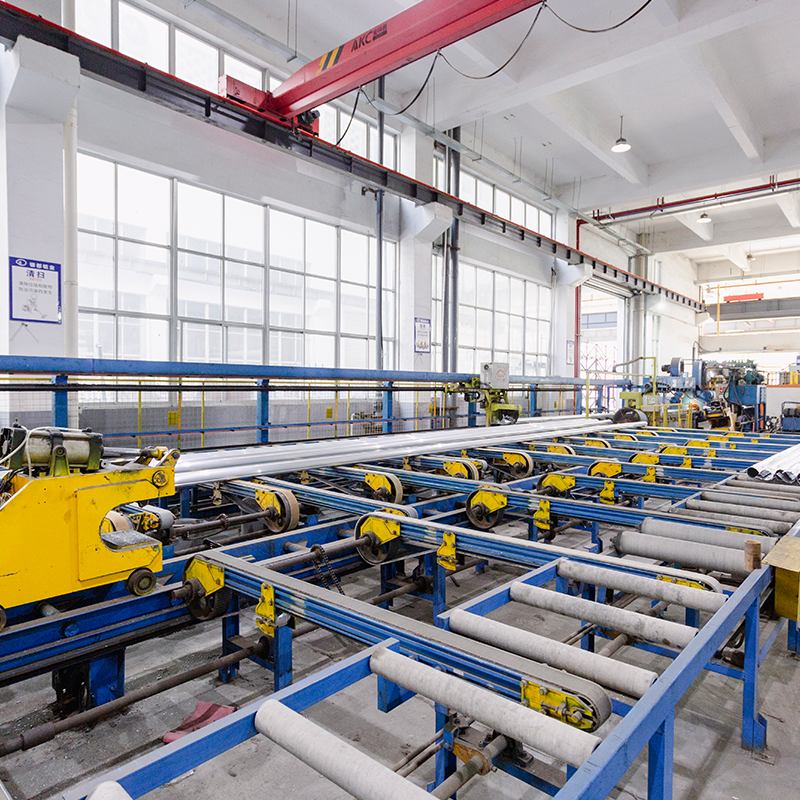
More than 90% of aluminum profiles are produced by direct extrusion, where a ram pushes the billet in the same direction that metal flows through the die. A complete production line follows this sequence:
- Billet heating — 6063-series billets are cut and heated to 420–480°C, soft enough to flow but never molten.
- Die preparation — the H13 tool steel die is preheated to around 450–500°C to prevent thermal shock and ensure even metal flow.
- Extrusion — a hydraulic ram applies 1,500–15,000 tons of force, pushing metal through the die opening at 3–180 m/min depending on alloy and geometry.
- Quenching — controlled air or water cooling at the exit locks in the metallurgical structure; 6061 requires water quenching to reach T6 properties.
- Stretching — profiles are stretched 1–3% to straighten them and relieve internal stress.
- Cutting and aging — profiles are cut to length and artificially aged: T5 tempers bake at roughly 180°C for 4–6 hours, while T6 adds a solution treatment near 530°C before aging.
Choosing the Right Alloy: 6063 vs 6061 vs 6005A
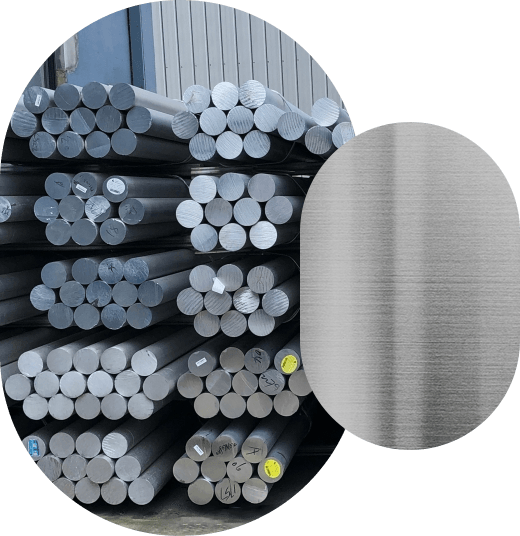
6063 accounts for roughly 80% of architectural profiles thanks to its excellent surface quality and extrudability, while 6061 is the default for structural parts that need higher strength. The most common extrusion alloys compare as follows:
| Alloy & Temper | Tensile Strength (MPa) | Yield Strength (MPa) | Elongation (%) | Typical Applications |
|---|---|---|---|---|
| 6063-T5 | 160 | 110 | 8 | Window frames, trim, LED heat sinks |
| 6063-T6 | 205 | 170 | 10 | Decorative profiles, furniture tubing |
| 6061-T6 | 310 | 276 | 8 | Structural frames, automotive, marine |
| 6005A-T6 | 260 | 215 | 9 | Truck bodies, ladders, rail vehicles |
| 6082-T6 | 310 | 260 | 8 | Bridges, cranes, European structural work |
Two additional factors often decide the choice: thermal conductivity and the strength ceiling. 6063 conducts heat at roughly 200 W/m·K versus about 167 W/m·K for 6061, which is why LED and CPU heat sinks are almost always 6063. When loads exceed what 6061 can handle, 7075 (572 MPa tensile) exists but is rarely extruded — it is difficult to form and costs 2–3× more, so most designers thicken the section instead of switching alloys.
Design Rules That Control Cost and Quality
An extrusion die behaves like an elastic tool: every geometric feature of your profile changes how metal flows and how long the die survives. Four rules drive most of the cost difference between a cheap profile and an expensive one.
Wall Thickness
The practical minimum wall is about 1.0 mm for 6063 and about 1.5 mm for 6061, but walls under 1.2 mm raise scrap rates and die deflection risk. Since raw material typically represents 60–75% of part cost, removing 0.5 mm from a non-critical wall is often the single most effective cost-reduction step available.
Circumscribing Circle and Press Size
Every profile must fit inside the die's circumscribing circle, and the circle diameter determines which press — and therefore which price tier — your order runs on:
| Billet Diameter | Typical Press Force | Max Circumscribing Circle |
|---|---|---|
| 6 in (152 mm) | 1,500–1,800 t | ~125 mm |
| 7 in (178 mm) | 2,000–2,500 t | ~165 mm |
| 9 in (229 mm) | 3,000–3,500 t | ~230 mm |
| 12 in (305 mm) | 5,000 t and up | ~320 mm |
Keeping the circle under roughly 165 mm keeps the profile on a common 7-inch press and avoids the surcharge applied by larger presses.
Geometry Balance and Die-Friendly Features
- Keep cross-sections as symmetrical as possible — asymmetric profiles bow and twist at the die exit, adding straightening work and scrap.
- Limit slot depth to about 3× the slot width; deeper, thinner "tongues" deflect under pressure and cause dimensional variation.
- Add corner radii of at least 0.5 mm to reduce stress concentration, improve metal flow, and extend die life.
- Hollow sections require porthole dies and always produce weld seams — position seams away from high-stress or visible surfaces.
Dimensional Tolerances and Standards
Tolerance class is one of the most frequently over-specified — and over-paid — items on a drawing. Standard tolerances cover most structural and architectural work; precision classes should be reserved for mating parts and mechanical assemblies.
| Standard | Region | Typical Tolerance (Dims ≤ 30 mm) | Typical Use |
|---|---|---|---|
| EN 12020-2 | Europe | ±0.10 mm | Precision assemblies, sliding and mating parts |
| EN 755-9 | Europe | ±0.20 mm | General structural and architectural profiles |
| ASTM B221 | North America | ±0.15–0.25 mm | Structural, architectural, and marine work |
| GB/T 5237 | China | ±0.15 mm (high grade) | Export architectural profiles |
Beyond cross-sectional dimensions, specify straightness (typically 1–2 mm per meter), twist, and flatness for long or wide profiles, since these form tolerances are controlled separately within EN 755-9 and EN 12020-2.
Surface Finishes and Their Trade-Offs
Mill finish is free and adequate for concealed structural parts, but most profiles receive a functional or decorative coating. The choice mainly affects corrosion resistance, color options, and cost:
- Anodizing — grows a 5–25 μm oxide layer with surface hardness of 300–500 HV; the standard for heat sinks, trim, and marine parts, and it preserves the metallic look.
- Powder coating — applies a 60–120 μm polymer film in 200+ RAL colors; the architectural default, with Qualicoat Class 2 systems rated for 10+ years outdoors.
- Electrophoretic coating (e-coat) — deposits a 15–35 μm transparent film with excellent uniformity, often combined with anodizing.
- PVDF coating — a 25–40 μm fluoropolymer system with 20+ year weatherability, specified for curtain walls and coastal facades.
- Wood-grain sublimation — transfers wood patterns into a powder-coated base for decorative interior profiles.
Anodizing and powder coating each typically add 10–25% to part cost depending on film thickness and color, with bright-dip and metallic anodized finishes at the top of that range.
Applications and the Four Cost Drivers
Demand for extruded profiles concentrates in five major markets:
- Building and construction — about 30% of global volume: window and door frames, curtain walls, railings.
- Transportation — about 25%: EV battery trays, bumper beams, and rail car bodies, mostly in 6061 and 6005A.
- Electronics and thermal management — LED luminaires and CPU heat sinks exploiting 6063's 200 W/m·K conductivity.
- Solar energy — 6063-T5 frames and mounting rails for the majority of PV modules.
- Industrial automation — T-slot framing systems (4040, 4080, 8080 series) for machine guards, conveyors, and workstations.
What Determines the Price of a Profile
- Raw material — the LME aluminum price plus regional premium typically represents 60–75% of total part cost, so profile pricing tracks metal markets closely.
- Conversion complexity — thin walls, hollow sections, and tight tolerances push extrusion and aging costs, typically $0.5–1.5 per kg.
- Tooling — an H13 steel die costs $800–3,000 one-time and usually lasts for more than 100 tons of production, so die cost per part becomes negligible at volume.
- Finish and order quantity — surface treatment adds 10–25%, and most mills set minimum orders of 300–500 kg per profile.
For most projects, the default specification is 6063-T5 with standard EN 755-9 or ASTM B221 tolerances and an anodized or powder-coated finish; switch to 6061-T6 only when structural loads demand it, and pay for precision tolerances only on surfaces that genuinely mate with other components. Get wall thickness, circumscribing circle, and symmetry right on the drawing, and extrusion will deliver the lowest cost per meter of any metal-forming process.
Previous Post
CNC Aluminum Extrusion: Process, Cost & Machining Guide
Next Post
No next article

Address
No. 18, Industrial Park, Yanghua Village, Nanxun Town, Nanxun District, Huzhou City, Zhejiang Province, China
Quick Menu
Subscribe newslatter
Copyright © Huzhou Yindu Aluminum Technology Co. , Ltd. Rights Reserved.
 Custom Aluminum Extrusions Manufacturers

